
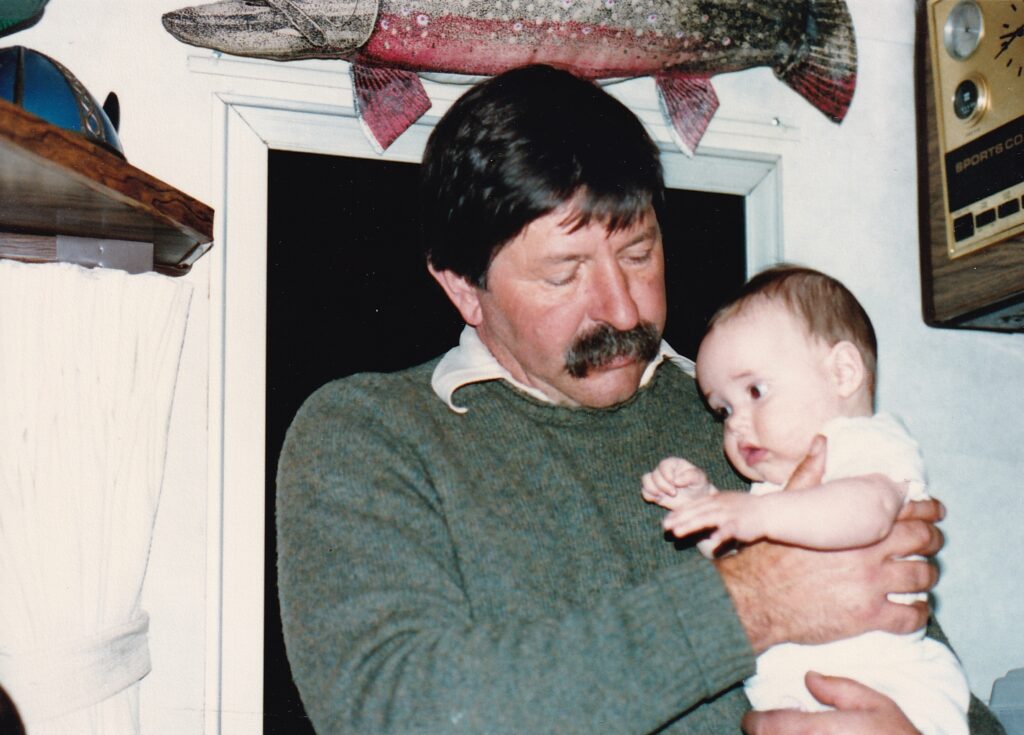
As many of you know, Leonard Lenger, Jr. is a long-time surveyor on the Central Coast. The editors of Parallax thought that it would be a good time to visit Leonard and have a chat with him about his life. Thankfully, Leonard was willing to sit down with us in late June. The interview was more of a roaming chat of his life and philosophies than is reflected in the organized interview that follows.
Parallax: Where did you grow up?
Leonard: I was born and raised in San Luis Obispo and still have the house I was born in. When I was in high school, there was mandatory military service and I was eager to get that out of the out of the way. We had a navy reserve unit based at the local airport and I joined during my junior year. We were just ending the Korean conflict and several of my friends were doing the same thing. This was fortunate as some other friends who kept deferring their military obligation ended up going to Vietnam.
After high school I joined a construction battalion which was based in Guam. I indicated I would like to work on a survey team but they said they had a greater need for someone to help keep track of their construction material. They won, but they did let me go out in the field periodically, one day a week, maybe, one day every two weeks. The survey crew was laying out taxi ways for our expanding airport and I got to see some of that being done. I didn’t learn much but felt important. It was a bookkeeping job, just with paper spreadsheets containing all the materials and different things that we were using. We spent one year in Guam then the battalion rotated to Alaska. The battalion went up to Alaska, but I was sent to Oakland, California where I and three others worked to ensure the battalion was obtaining the material they needed. I enjoyed San Francisco!
Parallax: Did you get into land surveying after getting out of the military?
Leonard: When I was released from the service, I started going to Cal Poly. I was thinking that I wanted to be an architect. I had a summer construction job but thought something in an architect’s office would be better. I went looking for work but didn’t find anything at an architect’s office. I did find an engineering office in Santa Maria that did have an opening. They had a guy that wanted to go on vacation, and they wanted someone to prepare maps. At the interview I had my sample drawings with me, to show what I could do and they hired me. Kenneth Wright, the owner, was an Engineer and Surveyor that had worked for J.D. McGregor and I understand eventually bought McGregor’s firm.
I learned how to do the calculations that were needed on survey maps. I also learned what about Tract or Subdivision Maps, Records of Survey, curb & gutter (road widening) plans during my two years with Ken.
Then Robert Ledger bought Ken Wright’s business, and I was now working for Bob.
We were preparing facility maps for Union Oil Company. Locating their roads, well sites and various pipelines. I started going out with the crew because the notes coming back were just too hard to follow. I was taking a stool, a drafting board, a protractor, and a ruler. I was drafting the field notes like you would with a plane table. The crew would call out the azimuth, distance and point description and I would plot the data.
Other times I was assisting when it was useful to have a third person like in construction staking
I worked for Bob Ledger for about six years.
Parallax: Do you remember any stories those older surveyors told you?
Leonard: When I worked for Kenneth Wright, he had been in the hospital for quite a while and then home confined. I would take maps to his house for him to sign. We would talk about the office and whatever popped into his mind. There are two I remember. The first is about contractors destroying monuments placed in the roadways
One particular monument, which I think was at Church and Main streets in Santa Maria. He had to replace it several times, so finally he poured concrete around it, about 1/4 yard of concrete around this pipe. Then one time as he went by this site he saw a tractor, and it was working as hard as it could to dig it out. I looked at Ken and his head was down slowly shaking back and forth at the memory. He couldn’t understand the lunacy of it. Why?
His other gripe was going to court. He would say about how he would survey a particular line where there was a dispute. He would have it all figured out, but then the judge would just listen to the people talking and based on his whim, the judge would decide where the corner should have been and how to resolve the boundary dispute. And it really irritated him because it wasn’t based on any fact. It was just based on what the judge wanted to do.
When I was working for Bob Ledger, we were surveying a portion of a county line in partnership with Curtis Brown. One time Curtis and I were in the office together and no one else was there. It was lunchtime, so the two of us went down to Denny’s. I was always a little uneasy around Curtis, worried I might say something foolish and he was starting to tell me about giving testimony. I was really interested in the story and when our lunches came, I was on auto pilot, not paying attention to our food and just pouring on the onions and stuff that came with the little cups all over my hamburger. I was really going for it. Curtis kind of hesitated , he asked me “Do you remember what you ordered?” The waitress had switched the plates. And I wasn’t paying any attention at all. I was just enthralled being with Curtis Brown. I admitted I didn’t and he said he thought the plate in front of me was his. We switched plates. He was fine but I felt like I had just done what I was worried about. Anyway, he was telling me the story about a boundary dispute where the location of a corner was critical and easily went on with his tale. He had found the corner, a rock with its marking. He knew the other side was going to try to cause some authenticity issue about it. He was thinking how he could support his story as he put a cow pie on it to help him find it again. The next day, they were having a field trip as the judge wanted to go out and see this terrain because of all the testimony there had been about establishing the corner. At the property, they were looking around and looking around, and pretty soon the judge asked, “Well, what am I looking for?” Curtis very carefully said, “Well, it is a marked stone but could be in a pile of grass or something, or it even have a cowpie covered it over the top. You have to clear the ground to be sure”. The judge is looking around and pretty soon he kicks the cow pie and he finds the monument! So, there is no question now in Curtis’s mind that this judge would not accept anything but the corner HE had found. Curtis side won the case.
Parallax: What made you think about becoming licensed and what was your process for getting licensed?
Leonard: When I was in my mid to late 20s, I saw 30 on the horizon. I asked myself, “Was I going to to take action and if so what? I admitted I liked what I was doing. The field-office combination was attractive why don’t I start studying for it and see where it takes me. There was a guy at Caltrans also who was trying to get people licensed. I can’t remember his name, but he was trying to get licensed himself. And so, he started some classes. Caltrans had some study material as they were encouraging their survey crews to obtain their licenses.
Also, it was a matter of meeting the qualification requirements for taking the exam. At that time, you needed a minimum of eight years of total experience, one year in the responsible charge in the office and one year in the field. I believe you could trade some of the experience for education. I was the office manager for Bob Ledger, and I was running the crew, telling them what they were doing, handling the notes, as well as doing the drafting. I never was a party chief, but I was controlling the field worked for my responsible charge time.
When I took the test, like I said, I was never a good student. It turned out I was dyslexic. And one of the things that I have the biggest problem with is writing and spelling. It was my first wife who was becoming a teacher who realized that I was dyslexic. At that time the exam was heavily written. I didn’t do very well. And I ended up taking it, I think, three times before I passed it.
Parallax: You have had your own surveying firm for quite a while, what made you go out on your own?
Leonard: Toward the end of my working with Bob Ledger, I started getting a little bit of a personality conflict with Bob. I wasn’t as happy working there as I had been and it was getting worse. I liked Bob a lot, I always did, but I told Bob that I had to quit and I did; I wasn’t licensed at that point and I didn’t know what I was going to do, but I just had to quit. It wasn’t working. Then Bob had a job come through the office that he didn’t particularly want to do and asked if I wanted to do it. I ended up doing that on my own through him. I was his field worker on the job and it was supervised by him. But I was doing the work. I got my license during that period and started looking for a job with someone else as I did not want to be running my own office. It was a bad time. Nobody was hiring, but I had this one job that I was doing on my own, and then pretty soon somebody asked me if I could do something for them because they would see me out surveying. Then I had another job and then I had another one. And soon I was doing these jobs by myself. I realized I had to hire somebody to help me because it was tough doing it by myself. I enjoyed doing the surveying, but I knew that I was not a good businessman. That is why I didn’t want to start my own business because I watched my dad. He enjoyed doing what he did, but he wasn’t a businessman. He just enjoyed doing what he was doing.
I knew that I needed help. At a meeting once, Ken Kreeger said he was looking to start his business. And I said, we could give it a try if you want, and we started a partnership. Ken was supposed to do the field work and I was supposed to do office work. And we ended up kind of each doing both things because we liked doing both things. We each had our separate ideas, didn’t discuss them (didn’t have a plan) and ultimately went our own ways.
We closed our downtown office and I moved my office home for a while and then to an office on Pacific Street outside of the mail business company. It was there I closed the business and spent a short time working at Diablo.
Parallax: You were involved with CLSA from early on in its inception, how did that happen?
Leonard: When I was first involved in surveying, CLSA was not around, it was ACSM (American Congress of Surveying and Mapping) that was putting on conferences and had a Southern California Chapter. Mike Welch had been talking with some surveyors from southern California and as I recall, they were promoting having a California organization. And they were drumming up CLSA. Mike was talking to Bob Ledger about it and Bob was all for starting CLSA too. I don’t remember how, but several of us got together about starting a chapter and we realized we needed bylaws. Dave Hook said he had just done some bylaws with a Hunters Association or something like that, and he knew how to prepare one. I said I would like to help, so Dave, Bob and I met at my house, and we worked up a rough draft for our proposed chapter and it was presented to our assembled group. We started our chapter with Bob Ledger as the representative to the state CLSA. Mike Welch was up there about that time becoming an officer in the state CLSA association. That was the beginning of it and soon I started going to state board meetings in San Francisco as a chapter rep after Bob quit.
Parallax: What did you learn from having your own business that might be good for someone considering starting a survey business to know about?
Leonard: As far as making a business, running a business, I didn’t ever make a plan. I never tried to specialize in something. I never tried to make money. I should have done those things and would totally encourage everyone to seek advice in doing so. I feel totally lost in not having done so. I guess I didn’t because I never thought I was actually going to run my own company, but I did enjoy my job and work. I was like my dad. I enjoyed what I was doing. I wasn’t trying to make money. I just hoped that I was making enough. I mean, there came a time when I had to shut down because I wasn’t making any. I am not sure I was equipped to run a business. I thought that’s okay in surveying because you can do it by yourself. I needed to decide whether I wanted to make money or did I want to just enjoy my life? I think that’s something that I never considered. You have obligations beyond yourself. You have your family. And I didn’t address or consider it. It didn’t occur to me that I was not taking care of business. So maybe a person needs to really give it thought before they start a business, yet it’s possible just to do it by yourself, that could be your plan. These days it is even easier to do it on your own.
Parallax: Were there frustrations with running your business?
Leonard: I don’t know that I was ever cognizant of being frustrated. I mean, there were times when I didn’t know how I was going to function business-wise, money-wise, but I wasn’t frustrated.
Parallax: What about working with agencies in processing?
Leonard: Yes, the frustration of dealing with land planning regulations. The regulations seem more important than the project itself. that aspect of surveying, the rules and regulations of processing the project. The rules are not based on getting the job done. They’re simply fulfilling the requirements that the governmental agency has set up. They have rules and regulations to follow. That’s what their plan is, their business model. It’s not necessarily how to house people in the best way or even develop the people, the plan. I mean, a road must serve the people for transportation. Land planning is not something that we are taught in surveying, yet our history is that the surveyor is the one that laid out the roads. And the roads are what get to the houses. So that might be something that we were unprepared for. I mean, we learned it on the job.
Parallax: Are there particular surveys that you enjoyed doing?
Leonard: Flood certificates were sometimes interesting, because you look at each site a little differently, each house is different particularly at the flood zone fringes.
Boundary surveys are always interesting, especially when you have to resolve the deed. Well, the hard ones were always the most interesting, the ones that were more complicated. Some of the sectional surveys where we’re finding monuments that maybe were there or maybe were never there. The question that has to be answered is whether it was a fraudulent survey or did it actually happen and we just couldn’t find monuments because there was a mistake.
The ones that were more difficult were more interesting, that required more interpretive investigation. Then there are corners that we’re trying to find, were the corners original or were they reset corners? Are we resetting an original or are we resetting a reset monument on a boundary survey. When we don’t know whether the corners were originally set, or out of necessity corner locations established later. Do we build from those, or do we do these massive mathematical replacements.
My father was City Engineer in San Luis Obispo prior to World War II and told me he established some block intersections in the older areas of town from reviewing the home locations. In those cases the houses were the physical evidence of where the original surveyor positioned those blocks.
I have seen cases where a standard subdivision was determined to have an error in its boundary and the lots within the subdivision were marked. An attempt was made to ‘follow’ the intent by adjusting all of the lot corners. This is wrong. The intent is clearly expressed in the monument locations themselves and any errors, in this case the boundary, would be corrected there.
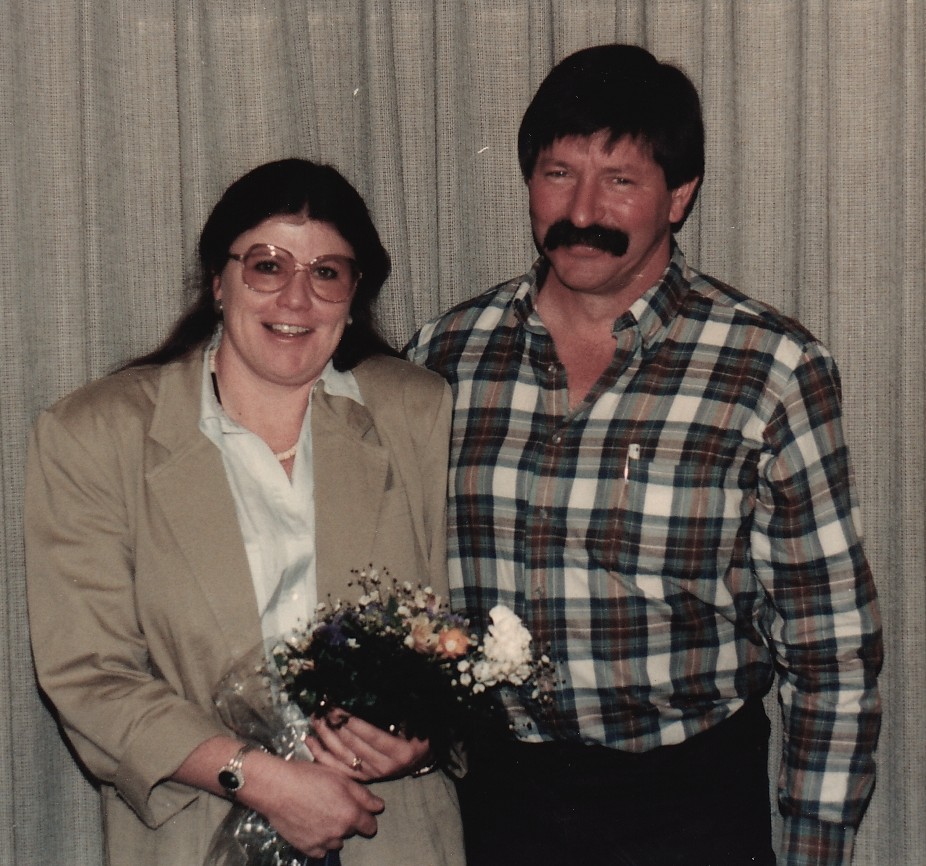
Leonard had been married to Susan Jensen for 40 years. Susan was also a licensed Land Surveyor and the first woman President of CLSA. Susan passed away in May of this year. She and Leonard owned and were the sole employees of Jensen Lenger Surveys for the last 40 years. We asked Leonard about Susan.
Parallax: I am not sure if you are willing to talk about Susan, and your relationship with her, it’s totally up to you.
Leonard: I would be happy to talk about Susan. She was working for a retail store in Visalia, and she was trying to move back over to San Luis. She’d gone to Cal Poly in her younger days, and she wanted to move back to San Luis and finish her senior project. Somebody had told her that I needed a secretary. She came to the house where I lived in San Luis, this old house and my office was the garage. It was really an old stable and the ceiling was leaking. She said she wanted a job, and so I said, okay, took her into the office and it so happened it was raining that day. She soon found out I needed somebody to take care of things as I never answered phone calls. She was always being hammered because I wasn’t returning the phone calls, wasn’t taking care of business. As Susan tells it, if the crew finished a job early, we’d just stop and shoot pool until we thought she was gone. And then we would go back to the office. I was clearly avoiding her. She decided that we were having more fun than she was and at some point, quit.
She had been around the courthouse enough that the people there knew and liked her. They offered her a job on the field crew. So, I taught her how to operate the instrument, how to set it up, and how to run it, how to turn angles and stuff. And then she went to work at the county and worked with John Austin, the party chief. She ran the gun and was very good at it. She was able to stand out in the middle of the street when the trucks were rolling by. And it didn’t faze her. She was one of the guys in that she fit in. She was part of the crew. When they were slow in the field, they had her drafting. So, I showed her how to do the engineering drafting and how to make the letters and stuff, because she had nice penmanship, but no experience in engineering drafting.
I’m not sure how she got back to my office, I guess she just wanted something that was less formal. Maybe we needed somebody in the office to do drafting at this point. I don’t recall, but she ended up back at the office at Lenger Surveys on Pacific Street and we began to date. At some point she got to Union Oil, I think that she met Jack Hamilton, the Union Oil surveyor, when she was going over there to get some research or something. Anyway, she met Jack and he offered her a job. He needed some help. And I remember her talking about it with me, and it sounded like a good deal. I mean, she was making some real money there. And it looked like an opportunity. She got licensed when she was working at Union Oil.
Susan had been going to chapter CLSA meetings for years but as soon as she became licensed, she became a chapter representative to the State association. After she went through the officer positions in CLSA she became involved in NSPS (National Society of Professional Surveyors). We were living in our current house at the time, and she was traveling back east quite a bit. I went with her a couple of times to the conventions back east. She wanted me to go with her just because she wanted the men to know that she had a husband. I would sit in the audience with the wives, and we would talk about recipes and babysitters. It was fun. I enjoyed the night.
She got burned out because people were not paying attention. The guys were going to the meetings, but they just weren’t functioning. They were just oblivious to what was happening. And she finally just said, “You know, what the hell’s the matter with these guys? Why don’t they, why don’t they take it more seriously? Don’t they realize what’s happening?”. She said enough was enough.
She also was someone who liked to learn something new. She started building, revamping houses. She was just finishing that phase when she started getting sick. She started cooking at home because that was the next thing that interested her, and we’ve got appliances and new spices and she’s always doing something new. I mean, she just really did it with enthusiasm. And we’ve got binders, 20 binders with recipes in it.
She got heavily involved in helping disadvantaged kids play soccer. She talked to people to fund these kids, to let the kids in because they were really good soccer players. She was furnishing them with clothing and convincing them to continue their education too.
Susan was one who when she got involved in something went all out. I have more of a problem with her passing than I realized.
Parallax: Leonard, thank you for the time and doing the interview with us.

Leave a Reply