

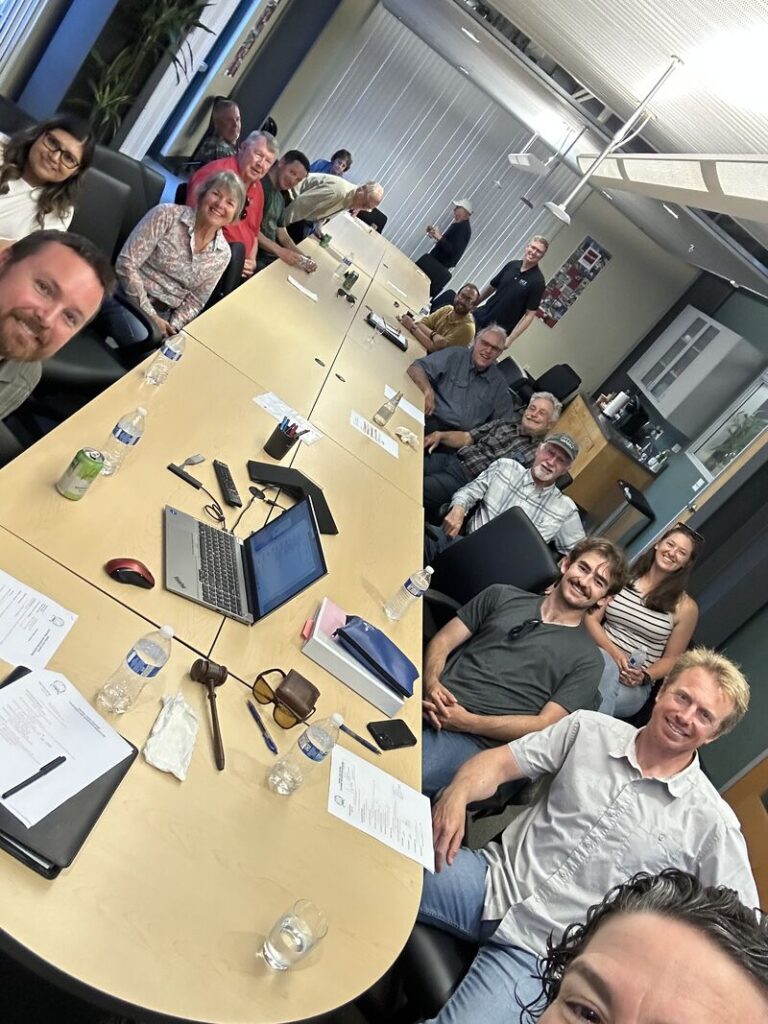
At the July meeting, President-Elect for The California Land Surveyors Association (CLSA) Kristie Achee brought up for discussion the idea of required continuing education in California for licensure. The participants in the room were evenly split regarding their support for the proposal, and a brief yet engaging discussion ensued concerning its necessity in California. I thought it would be a good idea to bring the discussion to all that read Parallax or to those who at least this read this article. Please feel free to comment about continuing education for land surveyors (see comment section at end of article).
I have always thought that continuing education for professional land surveyors is not only a good idea but also a way to improve the image of the profession, as well as improve professionalism. CLSA has grappled with the idea from at least the mid 1980’s that I am aware of. It has always failed at the CLSA Board level primarily because the Board support was about the same as the support we saw at the chapter meeting.
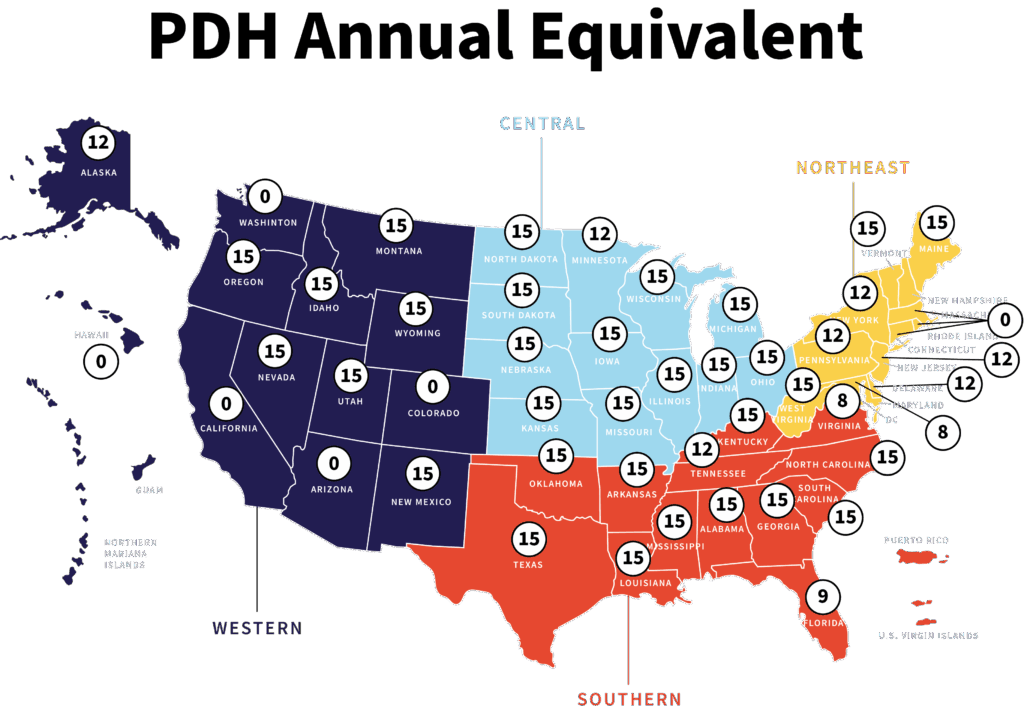
I thought instead of getting on my high horse (which just makes me hard to hear) I would just look at what the rest of the United States is doing as far as improving professionalism in land surveying (a bit of a higher horse). I had heard that most states have some sort of continuing education requirement and so I wanted to see how many actually do and what those requirements look like. I know that somewhere there must be a compendium of the state laws concerning this, but for the life of me I could not find it (probably need some continuing education concerning that). So, I did the next best thing, I went to each state’s (and DC) Board of Registration website and reviewed its laws concerning continuing education. Interestingly when I got to Nevada (where I just retired my license) under their overview of Continuing Education they had a map that showed Annual Equivalent for Professional Development Hours (PDH) per year.
I have attached a link to the spreadsheet I used to track the information for this article. I’ll summarize and synthesize the data, so you won’t need to review the spreadsheet unless you want more detail. The spreadsheet has links to each Board and some notes that I kept on most of the Boards. Click on the icon to download the spreadsheet.

It is easier to note which States do not have any form of continuing education requirements: Arizona, California, Connecticut, Hawaii and Massachusetts, for five in total.
There is quite a bit of variety in how the State Boards approach continuing education, but the most common general requirement is 30 PDHs in a two-year period. Many of the states have specific areas that must be covered within the required PDHs. Most common requirement is one or two hours of ethics classes. Also, a number of states require one or two hours of “Standards of Practice” or “Minimum Standards of Practice”. Some states require hours in other areas of expertise. Many of the states list acceptable courses, although all have ways to request or submit for acceptance courses outside of that list. Many of the Boards have links to resources that provide continuing education, and North Dakota even has a free on-line ethics exam that if you pass counts towards one PDH in ethics. I wonder if anyone cheats on that one…
Most common requirement is one or two hours of ethics classes. Also, a number of states require one or two hours of “Standards of Practice” or “Minimum Standards of Practice”.
Beyond the required areas there is quite a variety of what is acceptable as a PDH. Many states allow licensees to count being an officer in a professional association towards PDHs. Writing articles, teaching seminars, putting on workshops all count toward hours in most states. Most states specify in their laws and regulations the number of PDHs that can be credited for these activities. Many states would count meetings with a technical program, such as some of the meetings we have within our chapter towards PDHs. Some states are more restrictive in what is acceptable, limiting PDHs to specific seminars or classes. A review of all states indicated that their laws and regulations provided clear information regarding compliance requirements and the procedures for addressing noncompliance. Admittedly some states were far clearer, at least to me as to what had to be done.
The next concern is how you prove that you have met the requirements. Again, states varied on how that was handled. Most require the licensee to maintain a log with detailed information about the course or activity. Some had sample logs, online logs or recommended using the NCEES logging system. Some states require you to submit all your information to an online system that manages your log. However, most states do not require you to submit the log with your renewal application, they just do random audits and only then do you submit your logs. Most states require you to maintain the log for a number of years beyond the current. Most if not all states also allow you to roll over some PDHs if you have excess hours from one renewal to the next.
a number of CLSA webinars that counted towards PDHs. Some chapter meetings with technical programs counted toward my PDHs.
I can only directly relate to how these are managed for my Nevada license. Nevada law defines different activities (seminar, workshop, writings, officers, etc.) and how you determine the PDHs for that activity. The Nevada Board created a sample activity log based on the law for managing a licensee’s continuing education. I created a spreadsheet based on that log to record all the details I needed for each activity. I then had a binder with the information for each activity, such a certificate of completion, or verification of my attendance. I was never audited so I can’t say as to how that might have gone.
I would say that the hardest part about collecting my PDH’s was to record them in my log. I attended a conference in Reno and was able to collect the entire required PDHs for my next renewal. Over the years, I attended a number of CLSA webinars that counted towards PDHs. Some chapter meetings with technical programs counted toward my PDHs. I always had PDHs that I could roll to the next renewal. I think it takes minimal professional effort to meet the continuing educational requirements in most states.
A couple of side notes about looking at all the States. First there appear to be a number of scams where people are contacted by a “Board” needing some personal information from the licensee. I would say at least half the Boards had warnings about that. As you might imagine, the laws and regulations vary significantly from state to state. Some states have codified rules of ethics. Some have boundary precision requirements in the law. The websites and the ability to find out about the continuing education rules covered the spectrum also. Thankfully, all the websites had links to the state laws and regulations, and while some links were more specific than others, all gave me a starting point.
As the President-Elect of CLSA is interested in bringing up the Continuing Education quandary up in her year as President, it would behoove us to debate amongst ourselves as to what we as a chapter believe. Please comment below!!


Leave a Reply