

There has been a lot of talk over the last 20 (30?) years about the need for more licensed land surveyors. The U.S. Bureau of Labor Statistics (BLS) indicates that there are about 4000 openings for surveyors1 with a projected 6 percent growth over the next 10 years. As many of you know, the first licensing for any engineering discipline was a surveying licensure in California in 1891. I believe, without any evidence (or reason) that the first licensed surveyor did come from our chapter.
How Many Surveyors do we need?
The BLS indicates that there are a total of 53,080 active surveyors in the United States and 3,750 in California. That works out to about 7.1% of Surveyors are in California. Based on BLS projections of 4000 new surveyors per year, California would need about 280 new Land Surveyors each year (+ 6% growth). The BLS classification is just “Surveyor” but the “What Surveyors Do” is listed as “Surveyors make precise measurements to determine property boundaries.”. There is a separate classification for “Survey technician”.
How Many Professional Land Surveyors are being licensed in California?
If everyone who sat for the State Specific Professional Land Surveyor Exam passed the exam, we would almost make the 280 new land surveyors. As you might guess, not all passed. Also, there is no indication as to how many are retaking the exam.
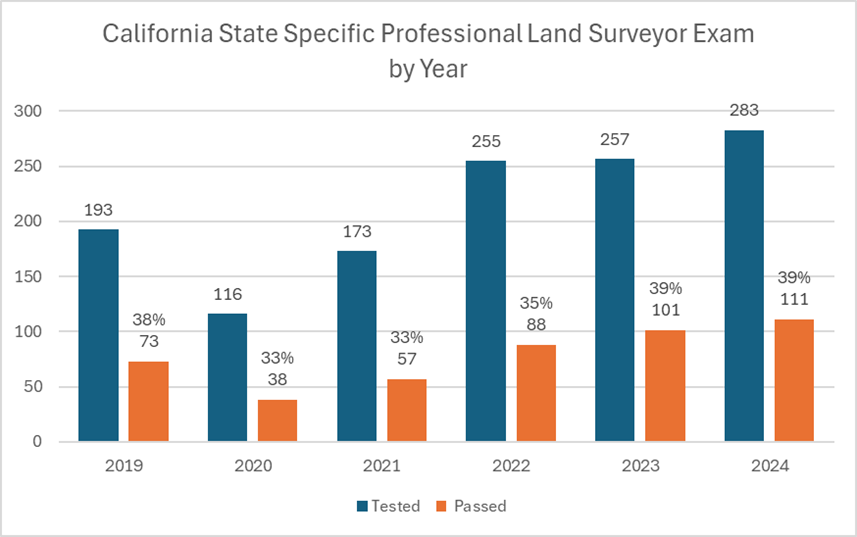
The good news is you can see that the decrease in examinees caused by the pandemic has been erased. The larger numbers in the last few years are probably a response to those pandemic numbers.
How about nationally?
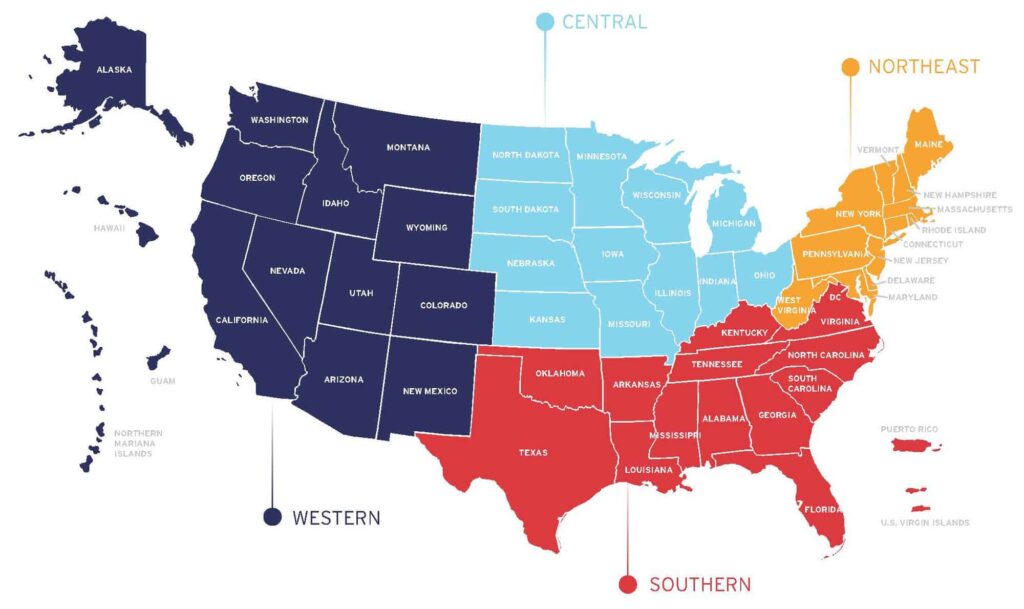
The next question is how the rest of the United States is doing, as we can probably convince some surveyors from the colder parts of the country to come work in sunny California (don’t tell them about housing costs).
The National Council of Examiners for Engineering and Surveying (NCEES) has statistics for each year of its tests2. So that would be a good place to look to see who else might be available. Their data do not line up exactly with BLS; NCEES says there are 3819 licensed surveyors in California, 634 who do not live in California and 47,392 in the United States, which comes to California having 8.1% of the active Land Surveyors.
NCEES also provides statistics on the pass rate for their exams including the numbers for first time test takers and for those that are repeating the test. Below is a chart showing the number of examinees and the number that passed. Looking at this chart, we are not getting the number of land surveyors passing to fill the need of the nation.
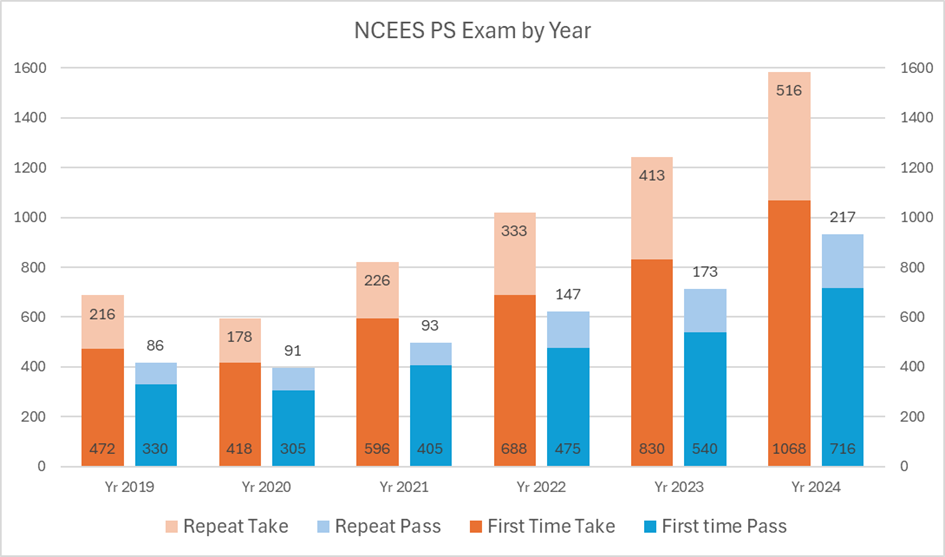
Again, similar to the State chart, there is a large upswing after the pandemic years. Looking at the pass rate, it appears that some people took advantage of the time at home to study for the exam!
What potential is coming through the pipeline?
So, the next item to look at is what the future holds. In California the only test to become a “Land Surveyor-in-Training” (LSIT) is the NCEES Fundamentals of Surveying. NCEES does not break down the exams by state, so the chart below is for nationwide testing.
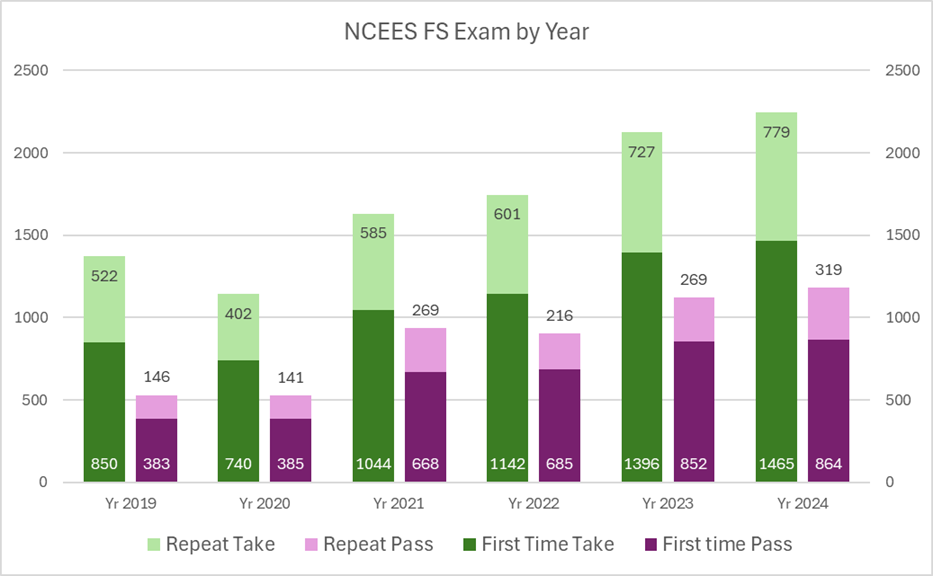
Although more people are taking the FS (Fundamentals of Surveying) exam than the PS (Principles of Surveying) exam, the number passing the FS exam is not that much higher than the pass rate for the PS exam and nowhere near those 4000 surveyors the country needs every year.
Conclusion
Based on the testing results we see, the demand will far outpace the supply. Anecdotally this is what many surveying firms have seen and felt during the last ten years. There have been many articles on this problem, and some have ideas on how to address the problem. There has been a push in many states including California to do public outreach, especially to students about land surveying as a profession. There is always talk about modifying the name we call ourselves to sound more interesting to younger people.
As with most problems it may take a number of ideas to solve the problem, and some attempts may fall flat on their face. I have always thought that as a profession, we appeal to people who enjoy detail work and not so much public relations work.

For those of you who are interested and have more energy than I do, there is a site that the National Society of Professional Surveyors (NSPS) put together, BEaSurveyor.com. It is a site for people interested in land surveying and it has a resources page that has some outreach material. There is also the “Get Kids into Survey” site which has material for getting young students aware of and interested in surveying. This Chapter has tried to promote that before, but it just takes one champion to make it possible to inspire young, budding surveyors in our area.
Items of Note
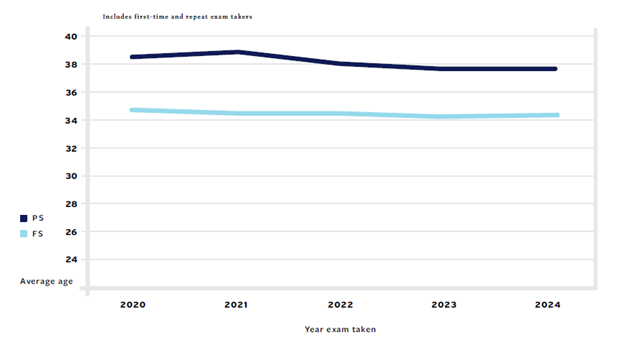
In reviewing the NCEES data t the Chart below was presented with the average age of applicants taking the FS and PS exams. First, in looking at the chart, the age for people taking the PS exam seemed reasonable. Looking at the FS exam age it seems like we are clearly not getting the message to people at a younger age.
Secondly, in looking at the Fundamentals of Engineering exam (FE), I noticed that Cal Poly, San Luis Obispo has the sixth largest group of students taking the FE among universities in the nation. That seems like a pond that locally could be fished for students wanting a better career than Civil Engineering. Cal Poly, Pomona was 8th on the list. These two were the only California universities in the top ten.
References
1 https://www.bls.gov/ooh/architecture-and-engineering/surveyors.htm

Leave a Reply